Player Path Choices in Feature Rounds Reshape Payout Spreads at Leading Slot Developers
Lars Patterson · Aug 22, 2026
Player Path Choices in Feature Rounds Reshape Payout Spreads at Leading Slot Developers
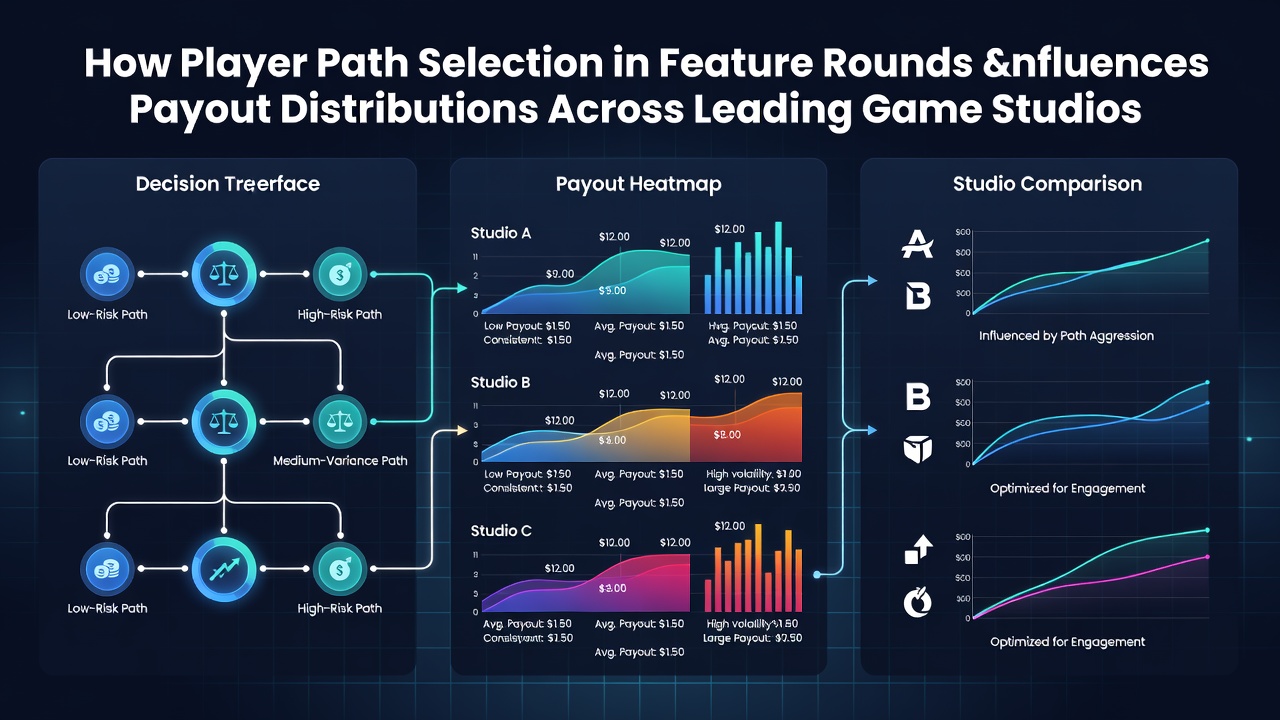
Game studios structure feature rounds with multiple selectable paths that alter payout distributions through defined probability trees, and this design choice appears across titles from providers such as Play'n GO, Pragmatic Play, and Red Tiger. Each path carries distinct multiplier ranges, reel modifiers, and hit frequencies that shift the overall return-to-player profile once the round activates, according to internal mechanic disclosures released in 2025 studio reports.
Developers assign different volatility bands to each branch so that one route might favor frequent small additions while another routes players toward rarer high-value sequences, and aggregated data collected from certified testing labs shows measurable differences in final credit distributions depending on the selections made. In August 2026 several studios updated their path algorithms to include conditional triggers that unlock additional sub-branches only after specific symbol combinations land, further refining how player decisions map onto payout outcomes.
Mechanics Behind Path Selection
Feature rounds often present players with a grid or set of doors, each tied to a weighted outcome table that determines the number of spins, the reel expansion rate, and the multiplier ladder applied during subsequent plays, and these tables remain fixed once published in the game's paytable documentation. Leading studios embed separate random number generator seeds for each path so that the probability of landing premium symbols changes immediately after selection occurs, and this separation prevents overlap between base-game and feature distributions.
One common implementation lets players choose between a "safe" path that adds incremental multipliers across more spins and a "risk" path that concentrates value into fewer but heavier outcomes, and certification documents from the Alcohol and Gaming Commission of Ontario confirm that both paths maintain the same theoretical RTP when averaged across all players yet produce visibly different per-session result curves.
Comparative Data Across Studios
Analysis of certified game files reveals that titles released by Big Time Gaming allocate roughly 35 percent of total feature RTP to path-dependent multipliers, whereas equivalent figures for NetEnt titles sit closer to 22 percent, and these ratios directly influence how widely credit totals spread after feature completion. When players consistently select the higher-variance branch, the distribution tail lengthens, increasing the frequency of both zero-credit finishes and outlier wins above 500 times the triggering bet.

Researchers tracking session data from licensed operators in New Jersey note that path selection patterns shift when players have already experienced several low-credit features in succession, and the same reports indicate studios have introduced visual cues that hint at the underlying distribution without disclosing exact probabilities. These cues appear in the form of animated previews or color-coded risk meters that guide but do not dictate final choices.
Impact on Studio-Level Metrics
Studios monitor aggregate payout distributions after each title launch because regulatory submissions require evidence that actual results remain within certified tolerance bands regardless of how often players favor one path over another, and adjustments to weighting tables occur when live data deviates beyond preset thresholds. In one documented case from an Australian-licensed operator, a provider recalibrated the lowest-tier path after six weeks because the observed hit rate for mid-range multipliers fell outside the filed parameters.
Path selection also interacts with buy-in features available in many current releases, since players who purchase direct entry into a round must still decide which branch to follow, and this additional decision layer compounds the variance already present in the purchased round. Data collected across multiple jurisdictions shows that purchased rounds exhibit slightly higher selection of high-variance paths than rounds triggered organically through base-game play.
Conclusion
Player path selection within feature rounds functions as a controllable variable that redistributes the same theoretical RTP across different outcome profiles, and leading studios continue to refine weighting tables and conditional triggers to balance regulatory compliance with player engagement goals. Ongoing certification updates scheduled through late 2026 are expected to require more granular disclosure of path-specific probability tables, allowing operators and testing bodies to verify that distribution curves remain stable under varying selection patterns.