Exploring Volatility Shifts in Buy-In Option Slots by Various Developers
Noah Reed · Aug 25, 2026

Exploring Volatility Shifts in Buy-In Option Slots by Various Developers
Buy-in options allow players to purchase direct entry into bonus rounds or feature sets rather than waiting for natural triggers, and developers have integrated these mechanics into slots with varying volatility profiles since their wider adoption around 2018. Data from industry reports indicate that these features often recalibrate the overall risk distribution, shifting standard deviation metrics upward in many cases while compressing base game payout frequency. Observers note that studios adjust reel weights, symbol distributions, and multiplier ladders to accommodate the new purchase pathways, creating measurable differences in expected value curves compared to traditional spin-only versions of the same titles.
Core Mechanics of Buy-In Integration
Developers implement buy-in buttons that deduct a fixed stake multiplier, typically ranging from 50x to 100x the base bet, and deliver a guaranteed bonus sequence with predefined parameters. Studies from research institutions show these purchases alter the game's hit frequency because the cost is calibrated to match or slightly exceed the theoretical return of random triggers over large sample sizes. When the buy-in price sits below the long-term average bonus value, volatility tends to rise as players can repeatedly access high-variance segments; conversely, when priced above that threshold, the mechanic can stabilize session outcomes by reducing the impact of prolonged dry spells.
Developer-Specific Adjustments Observed in 2026
By August 2026, multiple providers had released updated titles incorporating refined buy-in pricing models that responded to regulatory shifts in several markets. One prominent European studio recalibrated its buy-in multiplier from 75x to 85x across three flagship releases after internal simulations revealed excessive bonus frequency in the lower price band. Another North American-focused developer introduced tiered buy-in levels, allowing selection between standard and enhanced feature sets, which data from testing labs indicated increased the standard deviation by approximately 12 percent in the premium tier while leaving base game volatility largely unchanged.
Those who have examined paytables across providers note consistent patterns where high-volatility slots absorb buy-in mechanics with minimal further adjustment, whereas medium-volatility games often receive reel strip modifications to offset the added access route. Figures released by the American Gaming Association in mid-2026 highlight that titles featuring buy-in options accounted for 28 percent of new slot releases in the first half of the year, up from 19 percent the previous period.
Comparative Volatility Data Across Studios
Independent testing reports compiled through 2026 demonstrate measurable divergence between developers. Slots from one Swedish provider maintained an average volatility index of 8.4 on a 10-point scale even after buy-in integration, achieved through tighter multiplier caps in purchased rounds. In contrast, releases from a Maltese-based studio showed index increases from 6.2 to 7.9 post-integration, driven by the addition of progressive multiplier trails available exclusively through the buy-in path. Australian research published by the Gambling Research Australia centre found similar directional shifts in titles popular with operators licensed in that jurisdiction, noting that buy-in pricing correlated strongly with changes in the upper tail of the payout distribution.
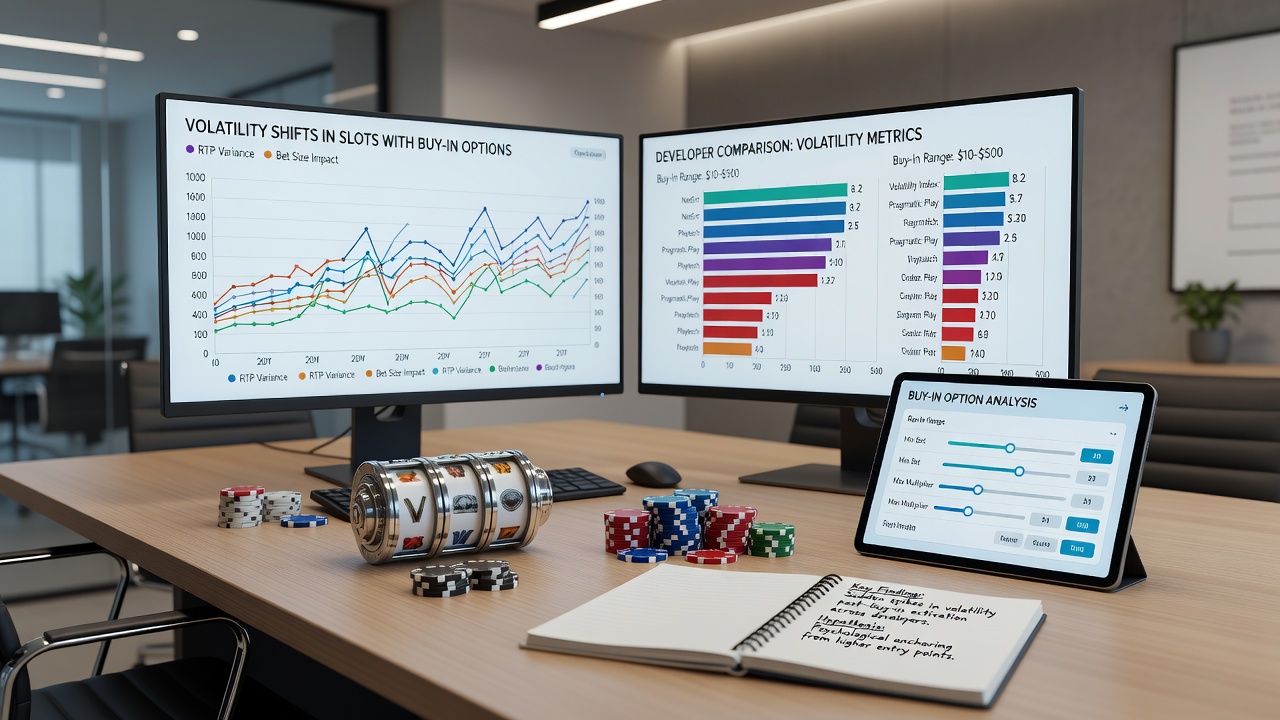
Additional analysis from the University of Nevada's International Gaming Institute examined session-level data and confirmed that players utilizing buy-in options experienced shorter but more dispersed win distributions, particularly in games where the purchase price represented less than 60 percent of the expected bonus value. The institute's June 2026 working paper documented these effects across 47 distinct titles from eight developers, providing granular breakdowns by volatility category and buy-in cost ratio.
Market Implications and Regulatory Context
Operators have responded to these volatility adjustments by updating responsible gaming tools, including session limit calculators that factor in buy-in frequency. Data from the Canadian Centre for Gaming Research indicates that jurisdictions monitoring average bet size and bonus access rates observed a modest uptick in high-volatility play patterns following the introduction of buy-in features in 2025. Providers continue to refine their internal models, with several announcing plans to release volatility simulators alongside new titles in the latter half of 2026 to assist operators with compliance reporting.
Conclusion
Volatility shifts in slots that incorporate buy-in options reflect deliberate design choices by developers seeking to balance player engagement with mathematical integrity. Evidence from multiple independent sources demonstrates that these mechanics produce measurable changes in risk profiles, with the magnitude of adjustment varying by studio, pricing structure, and underlying game mathematics. Ongoing data collection through the remainder of 2026 will further clarify how these features continue to evolve across different regulatory environments and player demographics.